Pages

Wednesday, April 26, 2006

From BBC

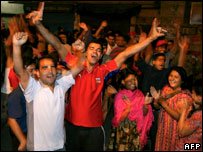
Nepalis celebrate protest victory

Thousands of Nepalis have held a victory rally in theKathmandu after the king gave in to their demands to reinstate parliament. The seven party opposition alliance said it had called off its weeks of demonstrations and a nationwide strike.

It has chosen former Prime Minister GP Koirala to head a new government.

But Maoist rebels behind a 10-year insurgency rejected King Gyanendra's deal with the opposition, and vowed to continue blockading the capital.

People gathered for the victory rally, waving party and national flags, and shouting slogans against the king from the roofs of vehicles.

"Gyanendra, thief, leave the country," shouted some protesters who had gathered near the royal palace, saying they would not stop demonstrating until the king was stripped of his powers.

'Ploy'

Meanwhile the city began to return to normal, after a crippling strike. Taxis were back on the streets, shops were reopened, and mobile phone connections were restored. Riot police were still in evidence, though.

Despite the hardships imposed by the strike, Nepalis insisted it had been worthwhile.

"It is only a small sacrifice for the good of the country," said Sabita Tamang, who has earned nothing from her grocery store for three weeks.

"The prices of food went up so high I had to cut down on what I eat," said Rajendra Sahi, a college student.

He added: "The people have done their part. Now it is the leaders who need to do theirs.

" The king assumed direct powers in February 2005, saying opposition parties were failing to manage the Maoist insurgency.

Communist Party (UML) leader Madhav Kumar Nepal told the BBC the formation of a new government would be "the first step towards a constituent assembly", which would be tasked with redrawing the constitution.

Maoists' next move

But the Maoists said in agreeing the deal with the king, the opposition had betrayed an agreement it made with them in November, which called for fresh elections and an end to an "autocratic monarchy".

The king's concession was "a new ploy to break the Nepali people and save his autocratic monarchy", said Maoist leader Prachanda in a statement.

Until the November agreement was implemented in full, they would blockade Kathmandu and all district capitals, the statement added.

Another senior rebel, Baburam Bhattarai, told the BBC: "The minimum demand is a free election to a constituent assembly."

King's address

During the recent protests, the demonstrators had repeatedly defied shoot-on-sight curfews despite the deaths of 14 people. Girija Prasad Koirala will head the new government In a late-night TV address on Monday, King Gyanendra expressed his "heartfelt condolences to all those who have lost their lives in the people's movement and wish the injured speedy recovery". He added: "We are confident that the nation will forge ahead towards sustainable peace, progress, full-fledged democracy and national unity." He said the lower house of parliament would reconvene on Friday. The US welcomed the king's announcement and said he should now consider assuming a "ceremonial role". More than 13,000 people have died in the Maoist insurgency. Violence has escalated since the rebels ended a truce in January - although they declared a ceasefire in Kathmandu this month as the street protests began.

Monday, April 24, 2006

New York Times

In a Retreat, Nepal's King Says He Will Reinstate Parliament
KATMANDU

Binod Joshi/Associated Press
There were street celebrations in Katmandu, Nepal, after King Gyanendra went on television late this evening to concede to the demands of the angry pro-democracy demonstrations.

A four-hour television series and interactive web site by The Times, The Canadian Broadcasting Corporation and the ZDF network of Germany.

His offer came on the eve of what were billed as the largest demonstrations to date. The political parties that began the protests 19 days ago had been preparing to encircle the city center on Tuesday. Instead, celebrations broke out late Monday night on the streets of the capital, Katmandu.
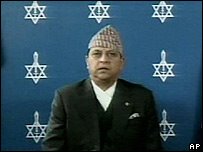
"We are confident this house will contribute to the overall welfare of Nepal and the Nepali people," the king, looking ashen, told the nation in an address broadcast on state-owned television. "We are confident that the nation will forge ahead toward sustainable peace, progress, full-fledged democracy and national unity."
For the first time, the king acknowledged the protests that have prompted hordes of Nepalese to defy shoot-on-sight curfew orders and have brought the capital to a virtual standstill. At least 13 people have been killed by police officers and soldiers since the demonstrations began. "We extend our heartfelt condolences to all those who have lost their lives to the people's movement," the king said.
He did not, however, explicitly address the demands for a referendum to redraw the nation's Constitution and let the Nepalese people decide on the future of the monarchy. The vote on the Constitution is a principal demand of the Maoist rebels, who have fought a bruising 10-year insurgency to defeat the monarchy.
They have lately linked arms with Nepal's political leaders and offered their blessings to the protests. Their influence has also been felt on the streets, with demonstrators ever more loudly calling for the end of the monarchy.
Whether the Maoists, Nepal's political leaders and the people in the streets would allow King Gyanendra to hold onto the monarchy remained an open question. It also remained to be seen whether the king's latest concession would be resisted by the more radical members of the opposition.
"This is the victory of the people on the street," Ram Chandra Poudel, a central committee member of the Nepali Congress Party, said minutes after the king's address.
The Maoists issued no comment on the king's speech on Monday night. But the previous night, the army said, they attacked government buildings in a small town barely five hours by road from the capital, luring the Royal Nepalese Army into a gunfight that killed six people, including one soldier.
Initially at least, protesters and political leaders greeted the address with glee, though the king stopped short of fulfilling what for him is certainly their most unpalatable demand: his abdication. The king did not renounce the throne, only the power he seized 14 months ago and retained with the help of the security forces under his command.
Certainly, he also gave up more than he had intended. Only three days ago, the king offered to allow the political parties to appoint a prime minister of their choosing. The parties turned down that offer, pinched as they were between pressure from the Maoists, their angry foot soldiers on the street, and their own distrust of the king.
Flouting pressure from abroad, party leaders insisted at the time that they would not stop agitating until the king agreed to reinstate Parliament and permit a referendum on the Constitution, which enshrines the monarchy and gives it control of the military.
Still, the king's offer on Monday to restore Parliament, effective Friday, was a significant retreat.
Within minutes of his appearance, the streets of Katmandu exploded in jubilation.
In the Tinkune section of the capital, a man with bandages around his head jumped and shouted. "I wouldn't mind losing my life for democracy," said Bhagawan Bhandari, 44. He had been injured by King Gyanendra's baton-wielding police force at a protest on Friday.
The State Department issued a statement saying that the king "should now hand power over to the parties and assume a ceremonial role in his country's governance," Reuters reported. The king's announcement came hours after the State Department had ordered all nonessential embassy staff and family members to leave the country.

Tilak P. Pokharel contributed reporting for this article.

April 24

.Full text of the royal proclamation
House of Representatives reinstated
KATHMANDU, April 24 - Beloved Countrymen,
Convinced that the source of State Authority and Sovereignty of the Kingdom of Nepal is inherent in the people of Nepal and cognizant of the spirit of the ongoing people's movement as well as to resolve the on-going violent conflict and other problems facing the country according to the road map of the agitating Seven Party Alliance, we, through this Proclamation, reinstate the House of Representatives which was dissolved on 22 May 2002 on the advice of the then Prime Minister in accordance with the Constitution of the Kingdom of Nepal-1990. We call upon the Seven Party Alliance to bear the responsibility of taking the nation on the path to national unity and prosperity, while ensuring permanent peace and safeguarding multiparty democracy. We also summon the session of the reinstated House of Representatives at the Sansad Bhawan, Singha Durbar at 1 P.M. on Friday, 28 April 2006.
We are confident that this House will contribute to the overall welfare of Nepal and the Nepalese people.
We extend our heartfelt condolences to all those who have lost their lives in the people's movement and wish the injured speedy recovery. We are confident that the nation will forge ahead towards sustainable peace, progress, full-fledged democracy and national unity.
May Lord Pashupatinath bless us all! Jaya Nepal!

People wins


Nepalis cheer climbdown by king
Nished Gautam

Jubilant Nepalis have taken to the streets in celebration after embattled King Gyanendra agreed to their demands to reinstate parliament.
"This is the people's victory! Long live democracy!" hundreds chanted in parts of the capital Kathmandu.
Opposition leaders say a huge anti-monarchy protest planned for Tuesday will now be a victory rally.
The king's announcement follows weeks of unrest by opponents to his absolute rule. At least 14 people have died.
A tired and tense-looking King Gyanendra announced the move in a late-night televised address, saying it was aimed at "protecting multi-party democracy and restoring peace".


He said the lower house of parliament would reconvene on Friday.
The US welcomed his announcement and said he should now consider assuming a "ceremonial role" in the country's governance.
On Monday, thousands of demonstrators defied a shoot-on-sight curfew in Kathmandu.
But the mood turned to one of celebration after the king's address at 2330 local time (around 1800GMT).
Hundreds streamed into the streets of Kathmandu and other towns, chanting, clapping and singing.
"The people from every corner are pleased to come and celebrate," bank employee Prakash Nepal, 40, told the Associated Press.
Condolences
The opposition alliance is due to meet to discuss the next step in resolving the country's crisis, opposition leader Shobhakar Parajuli told the BBC.
He said the mass rallies planned for Tuesday would go ahead, but would be a victory celebration and no longer a protest rally.

In his address, the king expressed his "heartfelt condolences to all those who have lost their lives in the people's movement and wish the injured speedy recovery".
He added: "We are confident that the nation will forge ahead towards sustainable peace, progress, full-fledged democracy and national unity."
The protests and a crippling strike led the United States to order all its non-essential diplomatic staff and their families to leave Nepal.
More than 13,000 people have died in the 10-year Maoist insurgency aimed at replacing the monarchy with a communist republic.
The king assumed direct powers in February 2005 saying parties were unable to deal with Maoist rebels.
Violence has escalated since the rebels ended a truce in January - although they declared a ceasefire in Kathmandu this month as street protests began against King Gyanendra.
A series of curfews have been in force in the city in recent days, but ignored by demonstrators.

bbcnews.com

Saturday, April 22, 2006


Embattled King of Nepal Offers Gesture to Protesters

Manish Swarup/Associated Press

Police officers used clubs to break up an antimonarchy demonstration Friday in Katmandu. King Gyanendra said later that he would turn over power to a prime minister chosen by the political parties, but his statement seemed to bring little relief in the national crisis.

By SOMINI SENGUPTA
Published: April 22, 2006
KATMANDU, Nepal, April 21 — Nepal's embattled King Gyanendra said Friday evening that he would turn over the reins of government to a prime minister chosen by the country's principal political parties, but his gesture brought little relief to a nation on the verge of paralysis.
Skip to next paragraph
Tomas van Houtryve for The New York Times
A photograph of King Gyanendra landed in a ditch Friday with other items tossed there by demonstrators in Katmandu, the Nepalese capital.
"Executive power of the Kingdom of Nepal, which was in our safekeeping, shall, from this day, be returned to the people," the king said, in a long-awaited, surprisingly short address on state-owned television.
Earlier Friday, more than 100,000 demonstrators flooded the heavily fortified main road in Katmandu, the capital, in defiance of a daylong shoot-on-sight curfew, gathering in the largest pro-democracy protests to date. By late evening, there was no official reaction from the country's political leaders, who were huddled in meetings and were to render their verdict on Saturday.
In a statement that said nothing about the king's address, the seven-party alliance that has led the demonstrators vowed to intensify the protests.
"The movement will continue like this until further notice," it read. "We call upon people from all walks of life to take to the streets and bring everything in the capital and all across the country to a complete halt."
The mood on the streets, swept by 16 days of often violent confrontations between pro-democracy protesters and the security forces, remained uneasy. At least 12 people have been killed by police officers and soldiers in the demonstrations, hundreds have been injured and several thousand arrested.
"There's nothing for those who were killed in these protests," Raj Narayan Thakur, 26, said of the king's speech, as bonfires burned on a street in a western suburb, Chabahil, and protesters milled around in the pitch dark.
"It doesn't work," said Bishwokiran Shakya, 46, with a brisk wave of his hand. "No good."
It remained unclear this evening whether the leaders of the seven-party alliance would seize the king's offer and, if they did, whether they could sell it to either the Nepalese people who have poured into the streets or the Maoist rebels with whom they have linked arms in a effort to wrest power from the palace.
In an accord signed last fall, the politicians agreed to the central Maoist demand for a referendum on the Constitution; in exchange, the Maoists agreed, among other things, to play by the rules of parliamentary democracy.
The king, who took over the government 14 months ago in what he said was an effort to defeat a Maoist rebellion, agreed to give up control of the state. But he did not address the two principal demands of the politicians and their foot soldiers on the street: restoration of the elected Parliament, suspended in May 2002, and a referendum to review the Constitution and decide whether Nepal still needs a king.
Calls for an end to monarchy, which is enshrined in the Nepalese Constitution, have grown louder and more brazen in the past weeks. The king's speech made it plain that he was in favor of maintaining the status quo: a multiparty democracy with a constitutional monarchy.
He spoke hours after Katmandu was engulfed in the largest protests to date, as several large neighborhood rallies converged on the sealed Ring Road that circles the city center. They shouted gleefully for the king's head, burned effigies and, at one point, toppled a small tin-roofed police post and set it alight, as a gantlet of police officers in riot gear, backed by soldiers, watched.
Apparently anticipating further discontent, the government extended the curfew on Friday evening until midnight.
There was no question that after two weeks of angry protests and a heavy-handed state crackdown, it will be harder for those clamoring for an end to Gyanendra's rule and the establishment of a democratic republic to accept any political deal that maintains the monarchy.
Favorable nods for the king came from abroad. Nepal's neighbor and most vital ally, India, swiftly endorsed the king's offer, saying in a statement that the king's words "should now pave the way for the restoration of political stability and economic recovery of the country."