Pages

Saturday, April 22, 2006


Why the world is watching Nepal
By Paul Reynolds World Affairs correspondent, BBC News website

Tourists hoping to visit a mountain Shangri-La have been surprisedWhile it would be an exaggeration to say that Nepal occupies a strategic position in the world - isolated as it is in the Himalayas - its future is being watched closely.
Partly this is for sentimental reasons. The kingdom used to be the destination of choice for thousands of Western hippies who thought of it as a mountain Shangri-la.
The one-time guru of the Beatles, Maharishi Mahesh Yogi, had connections in Nepal and once broadcast his vision of saving the world by "Transcendental Meditation" on Nepali television.
So there is a great interest in the West to see how that quiet and peaceful place (perhaps not so quiet underneath) has developed into the scene of civil war, repression, riot and uprising.
It is the government of India that is the most concerned. India itself has considerable problems with Maoist rebels
The Yogi's message does not seem to have worked. But then the 1960s and their message of flower power are a long time ago. The world has moved on in more violent ways, and Nepal is a part of that movement.
Then there is the Everest trek that keeps Nepal in a wider public eye. Currently teams of climbers are preparing for their attempts on the summit during the calm period between now and the end of May. They have largely escaped the recent troubles, although two climbers were injured last November when Maoist rebels attacked their vehicle on its way to base camp.
And there is the added factor in Britain because Nepal is home to the Ghurka fighters who serve in the British army.

Feedback

We salute people of Nepal: US
Kantipur Report

KATHMANDU, April 21 - The Unites States on Friday saluted the courage and resilience of the people of Nepal in their struggle for democracy and expressed the hope that King Gyanendra, who announced handing power back to people in his address today, would live up to his words.
“We are pleased that King Gyanendra’s message today made it clear that that sovereignty resides with the people,” said Sean McCormack, spokesman of the US Department of State. “We expect the king to live up to his words, and allow the parties to form the government.”
McCormack also urged the political parties – the seven-party alliance – to respond quickly by choosing a prime minister and a cabinet. “We urge all sides to refrain from violence to allow the restoration of democracy to take place swiftly and peacefully.”


The king has taken bold step: Karan Singh

Minutes after the nationally-televised address, India's Special Envoy Dr Karan Singh has welcomed the king's offer, saying the king has taken a bold step.
"I think it is the right thing to do to difuse the situation," he told the Post, adding, "Now the political parties have the shoulder the responsibility and take the process forward. The sooner that can happen the better, it will be."
The government of India is expected to make a statement along the same lines soon.

Politics

Full text: Nepal king's speech

The text of Nepal's King Gyanendra address to the nation, broadcast by Radio Nepal, in which announced handing over political power to the people and asked a seven-party alliance to choose a new prime minister.

Beloved Countrymen,
You are all aware that given the situation prevailing in the country then, we were compelled to take the decision of 1 February 2005 to set in motion a meaningful exercise in multiparty democracy by activating all elected bodies, ensuring peace and security and a corruption-free good government through the collective wisdom, understanding and the united efforts of all the Nepalese.

By supporting our decision, the Nepalese people made amply clear their desire for peace and democracy and the civil servants demonstrated sincerity towards their duty. We are appreciative of this. We also have high regard for the dutifulness, valour and discipline displayed by the security personnel by upholding their glorious tradition.


By visiting different parts of the country we made honest endeavours to acquaint ourselves with the hopes and aspirations of our people, mitigate their hardships and boost their morale. We also called on the political parties to enter into a dialogue in the interest of the nation and the people afflicted by violence and terror. However, this did not materialise.
The ideals of democracy can only be realised through the active participation of political parties.
In keeping with the tradition of the Shah dynasty to reign in accordance with the popular will, in the greater interest of the nation and people and our unflinching commitment towards constitutional monarchy and multiparty democracy, we through this proclamation affirm that the executive power of the Kingdom of Nepal, which was in our safekeeping, shall from this day be returned to the people and the exercise according to Article 35 of the Constitution of the Kingdom of Nepal-1990.


As the source of sovereign authority is inherent in the people, harmony and understanding must be preserved in the interest of the nation and people in an environment of peace and security.
While safeguarding multiparty democracy, the nation must be taken ahead along the road to peace and prosperity by bringing into the democratic mainstream those who have deviated from the constitutional path. Similarly, a meaningful exercise in democracy must be ensured with the activation of representative bodies through elections as soon as possible.
We therefore call on the seven-party alliance to recommend a name for the post of the prime minister at the earliest for the constitution of a council of ministers which will bear the responsibility of governing the country in accordance with the Constitution of the Kingdom of Nepal-1990. The present Council of Ministers will continue to function until the appointment of the prime minister.

May Lord Pashupatinath bless us all.
Jai Nepal

Friday, April 21, 2006

Gathering anger against Nepal's king

By Sanjoy Majumder BBC News, Kathmandu

Hundreds of people joined a protest in Kirtipur, Kathmandu
"I hope you've brought peace to our troubled land."
The immigration officer at Kathmandu 's Tribhuvan international airport looked up as he stamped my passport, resplendent in his blue uniform.
"We need democracy, total democracy not partial," he said.
"Make sure you put that in your report. Without democracy we cannot develop as a nation. Enough is enough."
For the past few days, the tide appears to have turned against King Gyanendra.
What started out as a political protest by a seven-party alliance, and then translated into a show of people power as Nepalis stormed the streets across the country, has finally crossed another frontier.
Professionals, lawyers and now bureaucrats - including from the all-powerful home ministry - have joined the struggle, some in spirit and others more substantially.
Public sentiment
The one institution above all others that has remained loyal to the king has been the Royal Nepalese Army.
But as flak-jacketed soldiers patrol the corner of every street in the Nepalese capital, they are acutely aware of the public mood.
"The public sentiment here is far too strong," says one local journalist.
"The protests have spread far wider and appear to be much more intense than those of 1990," he added, careful to remain unnamed, with the administration particularly severe against the media.
The king... is so removed from reality that he has to step aside
Lakshmi, protester
That was the year when the former monarch, King Birendra, was forced to usher in multi-party democracy in the wake of public protests.
The mood against his brother, who ascended the throne after King Birendra's brutal murder in the 2001 palace massacre, is equally strong.
On the eve of a planned mass protest in the capital, political rallies took place in pockets around Kathmandu.
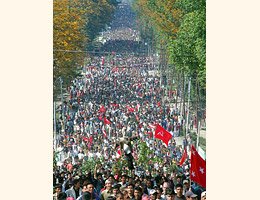
In the suburb of Kirtipur, more than 1,000 people gathered at the main market square as speaker after speaker railed against the king.
"This is a criminal regime," shouted one speaker, representing local traders.
"The king must go - he must go now."
"He must go - he must go now," chanted the crowd, cheering and clapping.
Single issue
Narayan Rathod Singh is a local member of the mainstream Nepali Congress Party.
He says things have moved beyond party politics.
"It is no longer important which party you belong to or what you believe in," he says.
The king is not somebody with our interests at heart
Pawan, protester
"There is only one issue before us - restore democracy.
"There is not a single person here who does not support that," he said waving his hand at the crowd.
"I grew up believing in the king and what the monarchy represents," says Lakshmi, who was attending the rally with her children.
"But the king has let us down. He is so removed from reality that he has to step aside.
"I don't think they should grow up in a Nepal which is an absolute monarchy," she says looking down at her little son and daughter.
Ravi Thapa and his friend, Pawan, are students.
He admits that joining the protests at first was fun - daring even - but that he had thought little about the issues at stake.
Now, however, he is clear in his mind.
"When the shootings started and the beatings I knew that this was serious.
"I also realised that the king is not somebody with our interests at heart. If he did, he wouldn't have filled the jails with ordinary people.
"He wouldn't have ordered his army to open fire on innocent civilians.
"He is not an aristocrat - he's an autocrat."
A few hundred metres away from the Kirtipur rally, smoke rises from a still smouldering burnt tyre.
Children run past it shouting, unmindful of what it represents.
But for King Gyanendra, safely ensconced behind the high walls of Kathmandu's Narayanhiti Palace, it is a sign that the public mood could quite easily turn ugly.

Time's run out

The Kathmandu Post


The rulers and elite have always ditched the Nepali people. The dark history dates back to 1768, when a smart warrior king unified the country with the help of the poor people, but his successors never recognized their rights and sovereignty. The oppressed denizens, who woke up to fight for their rights in 1950, successfully toppled the Rana oligarchy. Unfortunately, the 1950 agreement brought the monarchy to the fore. Consequently, the successive monarchs played the "cat-and-mouse" game with people's representatives to deny their rights. In December 1960, King Mahendra ousted the elected government and established the autocratic Panchayati that lasted for 30 years. In 1990, the late King Birendra showed certain farsightedness and bowed down before the people. However, the elite and monarchists immediately started hatching conspiracy against the restored democracy. In order to show one-upmanship to his slain brother, King Gyanendra usurped all state authority by staging a coup on Feb 1, 2005. But in just over a year, the king's move has culminated in a deep political crisis.
The Nepali people of 21st century have become so infuriated with the king that many wonder whether he will manage to save his crown. If the monarch dilays further to address the problem, the country will not remain a kingdom. For the king the time has run out. More than 12 people have already lost their lives since the people's movement waged by the seven party alliance began on April 6. On the fifteenth day alone, the security forces shot dead three protestors in the capital and critically injured dozens of demonstrators. No ruler can get away by killing innocent people. King Gyanendra will certainly be held accountable for the deaths and injuries of so many people. If the chairman-cum-king continues to play with the fire and refuses to bow down before the people, he is waiting for a political disaster.
Reportedly, the king is trying to seek a solution by appointing a middleman like former Prime Minister Krishna Prasad Bhattarai as the prime minister. But the movement has reached a new level of intensity where neither an individual nor any political party can rescue the monarch out of the current political imbroglio. We believe the king has gone to the extent of no return. Even if he restores people's sovereignty as per people's wishes, he may not be able to protect the 237-year old institution. The country is in flame. It has witnessed a dozen of deaths. Who is responsible for these deaths? The people know it well. If such peaceful demonstrations continue to see more deaths, the people would not accept any peaceful settlement. Let us hope Indian and other foreign envoys have transpired the message to the king.

Nepal braced for fresh protests


The protesters are demanding an end to absolute rule
The government of Nepal has imposed a new shoot-to-kill curfew in Kathmandu, in the wake of escalating violence between police and protesters.
The curfew, which will remain in force throughout Friday, coincides with a planned rally called by the opposition.
Police on Thursday opened fire on demonstrators who defied the curfew, killing three and wounding many more.
The protesters, who have staged mass strikes for the past two weeks, want the king to give up direct rule.
King Gyanendra sacked the government and assumed direct powers in February 2005, saying this was necessary to quell the long-running insurgency by Maoist rebels.
'Indiscriminate fire'
The opposition alliance has called for its supporters to demonstrate on Kathmandu's ring road on Friday.
Protesters burnt tyres on some city streets and on the outskirts ahead of the curfew, and opposition parties pledged to defy the curfew for the second day.
"So many people have come out on the street despite the curfew and crackdown. It is an indication that our movement has succeeded. We will continue this until the result comes in favour of the people," Nepali Congress leader Krishna Prasad Sitaula told Reuters.

The curfew began at 0900 (0315 GMT) and is not due to be lifted until 2000 (1415 GMT).
Government workers were asked to be in their workplaces before it took effect.
Police opened fire on Thursday as tens of thousands people tried to defy the daytime curfew.
Demonstrations against King Gyanendra's absolute rule or against the monarchy altogether had been going on for two weeks and the day was promised as the culmination.
Huge groups of anti-royal protestors, totalling perhaps 100,000, approached the capital from all directions, in each case coming up against barrages of security forces guarding the curfew zone.
On the north-east side of the city, the demonstration took place in a carnival atmosphere, the BBC's Charles Haviland reports from Kathmandu.
But at the western suburb of Kalanki, things turned violent when tens of thousands descended to the road from the hills.
HAVE YOUR SAY The king should understand he will never anymore be able to continue his regime. It is only a matter of time when he will fall down Sudeep Kafle, Kathmandu Send us your comments
Eyewitnesses said the police had opened fire indiscriminately and that in addition to those who died, many had been seriously injured.
Another person died on Friday in the town Gulariya, some 500km (300 miles) south-west of Kathmandu, after being injured in protests a day earlier, reports say.
At least 14 demonstrators have now died around the country in two weeks of protests.
A special envoy from India, Karan Singh, has held talks with King Gyanendra.
Indian diplomatic sources said he had conveyed Delhi's view that the monarch should urgently restore multi-party democracy.
Later, Mr Singh said he hoped the King would soon make an announcement to defuse the situation in Nepal.
"Certainly the situation has spun virtually if not out of control at least it is spinning out of control. Therefore some drastic and urgent steps are needed, and that was really my message to him," he said.

Deep meditation for peace of Nepal

India's key role in Nepal affairs

By Rabindra Mishra
BBC Nepali service

Recent clandestine meetings in India between leading Nepalese politicians and Maoist leaders have once again highlighted the crucial role India continues to play in Nepal's internal affairs.
Nepalese leaders have denied any face-to-face meeting with rebel leaders in India, let alone in a government guest house where talks are believed to have taken place.
For its part, India denies knowledge of any Maoist leaders on its soil and has declared them "terrorists". But it has been a long established fact that some top Maoist leaders do reside in India.
Since the 1 February royal coup, Nepalese leaders have regularly visited Delhi, but last week saw an unprecedented jamboree in the Indian capital.
Delhi 'check-ups'
What surprised many was the sudden visit of a leader of the Communist Party of Nepal (UML), Madhav Kumar Nepal, to Delhi.
Mr Nepal's visit took place less than a week after he had returned from an extended three-week tour of India, during which he met several Indian leaders, including Prime Minister Manmohan Singh.
As soon as he returned home, he had a series of meetings in Kathmandu with British Ambassador Keith Bloomfield, American ambassador James Moriarty and Indian Ambassador Shiv Shankar Mukherjee, as efforts to find a solution to Nepal's political impasse continued.
Mr Nepal then headed off to Delhi again after the meetings. Mr Moriarty, who has remained active in co-ordinating a uniform international approach towards Nepal, was already there.
Mr Nepal insisted he had gone for a "heart check-up", while Mr Moriarty said his was a regular visit for consultations with Indian officials.
Meanwhile, Nepali Congress president and former Prime Minister Girija Prasad Koirala was in Delhi too, also for a "health check-up".
And a leader of a smaller partner in Nepal's seven-party opposition alliance had gone there for his "son's health check-up". There were other leaders too.
Crucial time
What baffles many is the role Delhi is suspected to have played in all these movements.
Last week, the Indian foreign ministry denied any information about the latest meetings.
However, it is difficult to believe that the movement of top Nepali leaders in the heart of Delhi and meetings with rebel leaders declared terrorists at a politically crucial time could have gone unnoticed by the Indian authorities or intelligence officials.
General Ashok Mehta, a leading Indian security expert, believes that Indian intelligence established links with the Nepalese Maoists at least two years ago.
Speaking to the BBC, he once said "in circumstances as that of the Maoists, government strategy is implemented through intelligence agencies and not the official channels".
However, Indian Foreign Secretary Shyam Saran tries to avoid any direct reference to an alleged link between the Indian establishment and the rebels.
He said the Indian government was engaged in dialogue with all key political actors of Nepal, but did not mention the Maoists by name.
India was the first country to call the Maoists "terrorists" in September 2001, even before Nepal did so. At that time the Nepalese government was engaged in peace talks with the rebels.
Ironically, leading Maoist negotiator Krishna Bahadur Mahara travelled to Kathmandu from Delhi to participate in peace talks in November that year.

'Anti-nationalist'

India's role has been crucial in every major political change and the sustenance of such changes that Nepal has witnessed since the late 1940s.
After late King Mahendra sacked the elected government and took control of state power in 1960, the then Prime Minister of India, Jawaharlal Nehru, made his displeasure public.
However, within six months, his government had signed four aid agreements with Nepal and normal friendship resumed.
Many believe that the self-serving change in Indian attitude helped the continuation of the monarchy's rule for 30 years.
Similarly, many believe India played a crucial role in the collapse of the royal regime in 1990.
Supporters of the current king have been trying to portray Delhi-rushing leaders as "anti-nationalist".
However, it is very common for Nepalese political actors to maintain silence if the involvement of India helps them - and curse it if it does not.
The latest Delhi saga is only likely to strengthen the belief of many Nepalese that Kathmandu remains a hostage of Indian national interest, which they say, has led India to constantly manipulate the politics of its tiny, land-locked neighbour.